





















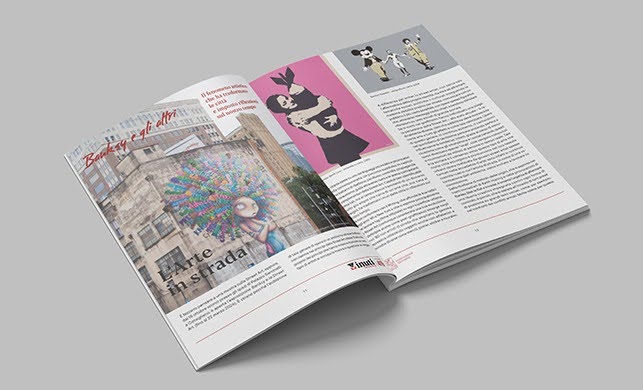
Some artistic languages emerge from art’s traditional homes: the studio, the museum, the gallery. Others are born elsewhere: on city walls, along the streets, in the spaces we walk through every day. Street Art belongs to the second family, and it takes centre stage in issue 419 of Minuti Art Edition, the Menarini Foundation’s magazine devoted to the works, artists and movements that best capture the spirit of their age.
The premise carries a paradox worth savouring: how do you tell the story of something as inherently boundless as Street Art within the four walls of a museum? A language conceived for public space, largely outside official channels, now finds itself the guest of honour in an exhibition venue. That is precisely what is happening with Banksy and Street Art, running at Palazzo Sarcinelli in Conegliano until 22 March 2026. The Veneto town is hosting a selection of eighty works built around urban art’s most persistent concerns: rebellion and pacifism, surveillance and propaganda, and the ever-present spectre of consumerism.
Where Street Art Comes From and What Sets It Apart
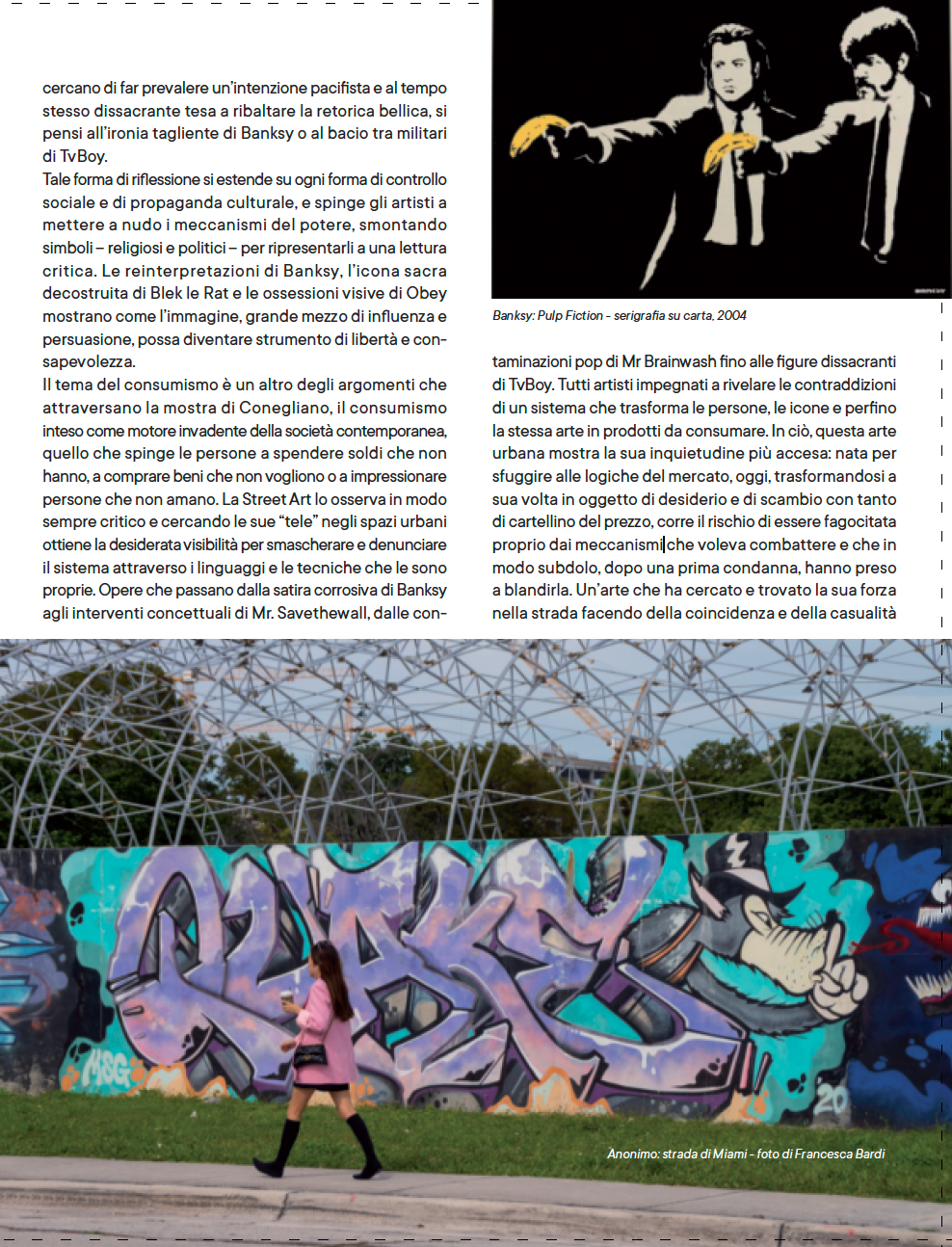
A distinction is worth drawing at the outset. Street Art is not Writing, the Graffiti movement that grew out of 1960s New York and revolved chiefly around the tag, the stylised signature scrawled across urban surfaces. Street Art proper took shape in the 1980s and parted ways with graffiti culture in both purpose and technique. Its practitioners widened the vocabulary considerably: figurative imagery, stencils, posters, stickers, murals. The point was no longer simply to stake out an identity, but to speak to as many people as possible, turning the city itself into a channel for social, political and cultural commentary.
This helps explain why the way Street Art is perceived has changed so profoundly over time. Long regarded as a marginal and often contested phenomenon, it has gradually earned recognition as a fully fledged artistic movement, one that shapes the collective imagination and now spreads with remarkable speed through smartphones and social media. A work that appears on a wall can reach, within hours, an audience far wider than any traditional gallery could offer.
Banksy, or the Fine Line Between Breaking Rules and Asking to Be Heard
In the account offered by Minuti Art Edition, Street Art reads above all as a way of claiming one’s place in cities that too often turn a deaf ear. From the unruly freedom of the early days to the provocations of Banksy, Blek le Rat, Invader, Obey, Mr. Brainwash, Mr. Savethewall and TvBoy, a common thread runs through the movement: the urge to unsettle the symbols of power, the rhetoric of war and the machinery of propaganda. Immediate, accessible and frequently laced with irony, these images invite passers-by to reflect on the contradictions of a society built on consumption.
And it is precisely the movement’s relationship with consumption that produces one of its most fascinating tensions. Conceived as an escape from the market, Street Art now risks being swallowed by it: works made for the street become collectors’ trophies, surface at auction and settle comfortably into the official circuit. The contradiction does not blunt the movement’s force: it sharpens its relevance.
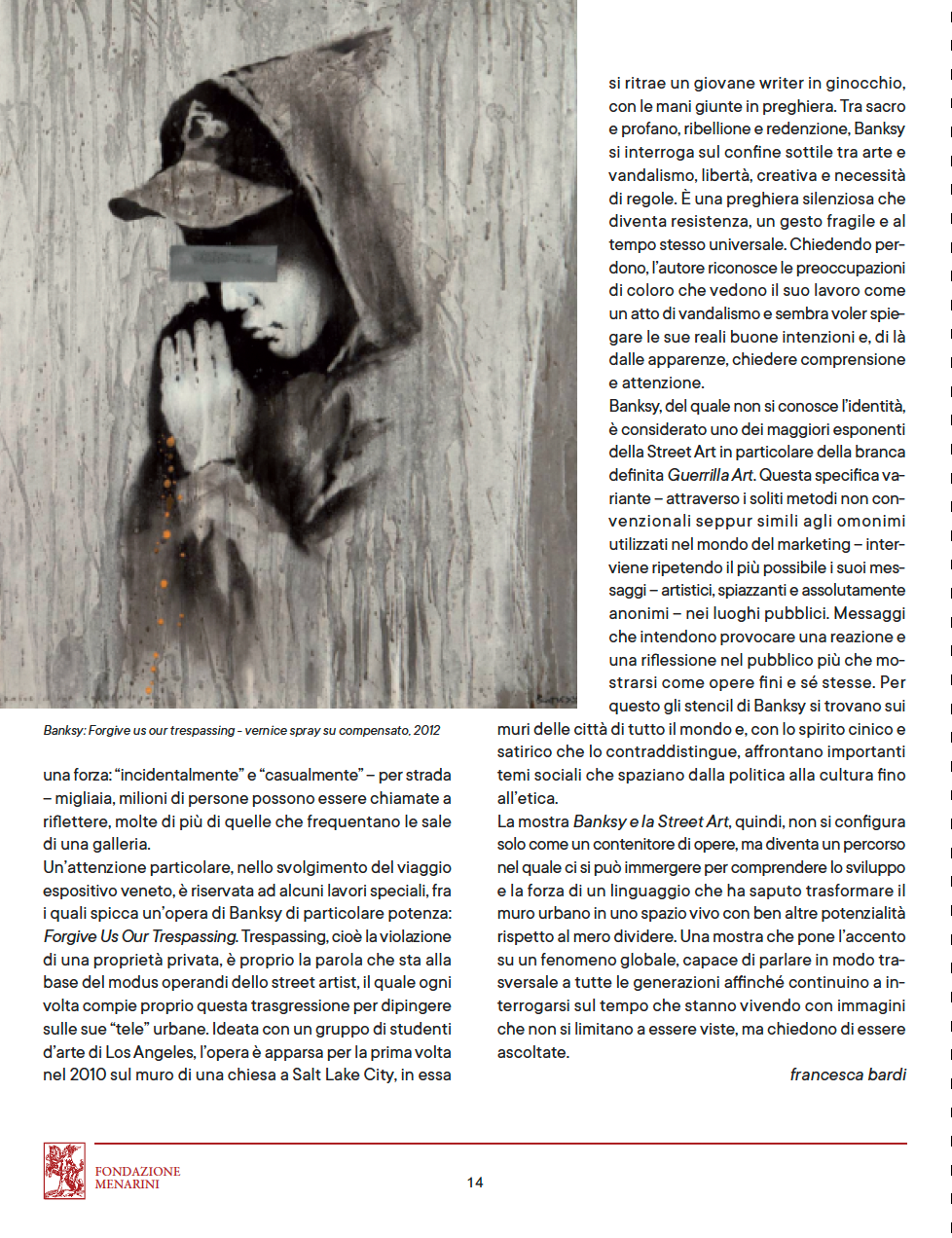
Against this backdrop, Banksy stands at the very centre. The mystery surrounding his identity, his mastery of the stencil and his gift for fusing wit, satire and social critique have made him the most recognisable face — or rather, non-face — of contemporary Street Art. Among the works discussed by Minuti Art Edition, Forgive Us Our Trespassing deserves special mention. First seen in 2010 on a wall in Salt Lake City, this monumental piece shows a young writer kneeling in prayer, hands clasped: a figure poised between the sacred and the profane, between the act of defiance and the hope of being heard.
The title turns on the notion of trespassing, the violation of private property that remains street art’s most contested aspect. With it, Banksy places front and centre the question that has shadowed the movement from the start: where does vandalism end and art begin? By asking forgiveness, his kneeling figure gives up nothing of the creative act, he simply asks us to look past the surface of the transgression.
Seen in this light, Banksy and Street Art becomes an invitation to trace the evolution of a language that has turned city walls into living surfaces, ones that stop us in our tracks. For a moment, standing before an image that has appeared overnight on a wall, the city ceases to be mere architecture and becomes a place where questions are asked.
Explore the full range of Minuti Art publications and draw inspiration from a cultural heritage that remains as rich as it is accessible.
Visit the Menarini Foundation website to stay up to date: https://fondazione-menarini.com/it.html